
Deep Learning for Generative AI — Part 8: The Transformer Architecture, Explained Simply
Deep Learning for Generative AI — Part 8: The Transformer Architecture, Explained Simply
In Part 6 we learned the big idea (Query, Key, Value and the group project). In Part 7 we watched the encoder enrich the words of one sentence.
Now let’s open the whole machine and look at every box in it. Still no heavy math. By the end you should be able to look at the famous Transformer diagram and explain each part to a friend.
We’ll use the same example as Part 7:
Input  (English):  Python program to print Hello World
Output (code):     print ( "Hello World" )
1. The full blueprint
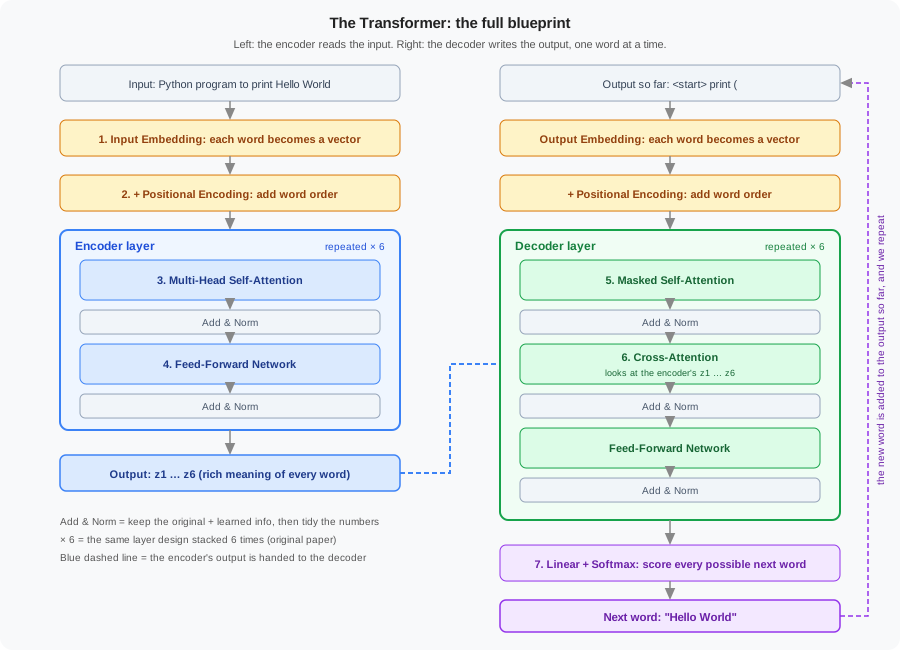
Think of it as a company with two departments:
| Department | Job | Analogy |
|---|---|---|
| Encoder (left, blue) | Read and understand the input | The reading team that studies the request |
| Decoder (right, green) | Write the output, one word at a time | The writing team that drafts the answer, checking the reading team’s notes as it goes |
The numbered boxes are the seven pieces we’ll walk through. Once you know those seven, you know the Transformer.
2. Box 1: Input Embedding (words become numbers)
Computers can’t read words, only numbers. So each word is first turned into a vector, exactly as in Part 1 (Word Embeddings).
"Python"  → [0.21, -0.40, 0.88, ...]
"program" → [0.19, -0.35, 0.72, ...]
...
In the original Transformer each vector has 512 numbers. Words with similar meanings get similar vectors.
Problem: these starting vectors describe each word alone. “program” gets the same vector whether it means code or a TV show. Fixing that is the job of everything that follows.
3. Box 2: Positional Encoding (giving every word a seat number)
Here’s a surprise. Attention looks at all the words at the same time. That’s what makes it fast, but it also means it has no idea of word order. To plain attention, these two sentences look the same:
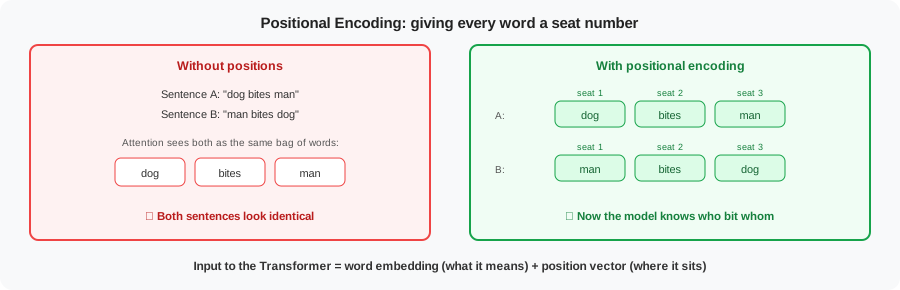
The fix is simple: add a position vector to every word vector.
input to the Transformer = word embedding (what it means) + position vector (where it sits)
Analogy: a cinema ticket. The ticket says who you are and which seat you’re in. Two people with the same name in different seats are clearly different.
The original paper builds these position vectors from sine and cosine waves of different speeds, so every position gets a unique pattern. You don’t need the formula yet. Just remember: meaning + position goes in.
4. The encoder layer
Every encoder layer has the same two main parts: multi-head self-attention, then a feed-forward network. After each part comes a small Add & Norm step.
Box 3: Multi-Head Self-Attention (several discussions at once)
This is the group project from Part 6 and Part 7: every word makes a Query, Key and Value, and each word ends up with a weighted blend of the other words’ values. (No re-explanation needed here — if Q, K, V feel fuzzy, revisit Part 6 first.)
Multi-head just means the team holds several discussions at the same time, each with a different focus:
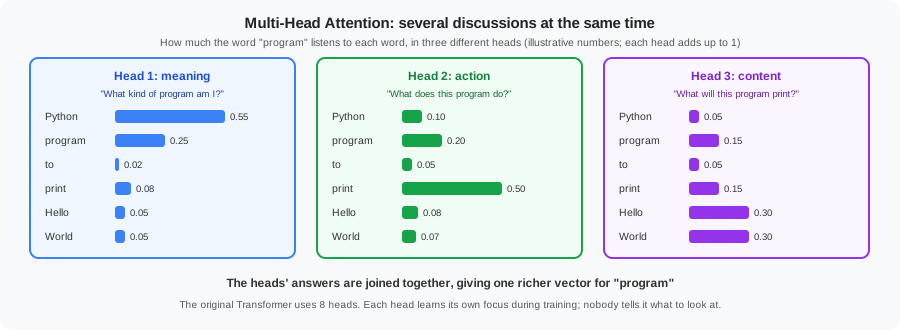
- Head 1 might learn “what kind of thing is this?” (program → Python).
- Head 2 might learn “what action is involved?” (program → print).
- Head 3 might learn “what is the content?” (program → Hello, World).
Each head produces its own answer. The answers are joined side by side and mixed into one vector. One discussion can only focus on one thing, but eight discussions can cover grammar, meaning, and more, all at once.
The heads above are illustrative. In a real model nobody assigns the topics. Each head discovers its own focus during training.
How the dimensions work
Multi-head attention splits the job, it does not add a separate full-sized attention for every head. Suppose the desired output size is D2 = 8 and we use 4 heads. Each head only has to produce D2 ÷ heads = 2 numbers per word:
Input X:                    N × 4   (each word starts as 4 numbers)
W_Q / W_K / W_V per head:   4 × 2   (one set for each head)
Output of one head:         N × 2

Head 1 output:  N × 2
Head 2 output:  N × 2
Head 3 output:  N × 2
Head 4 output:  N × 2

Concatenate side by side:   N × 8
Projection W_O:             8 × 8
Final multi-head output:    N × 8
The final N × 8 matrix has the same size as a single-head attention output, but each of its 8 components came from a different discussion. The extra projection matrix W_O mixes those separate discussions into one coherent vector.
The original Transformer uses d_model = 512 and 8 heads, so each head produces 512 ÷ 8 = 64 numbers.
Add & Norm (keep your notes, then tidy up)
After attention, two small housekeeping steps happen:
- Add (a residual connection): add the word’s original vector back to the attention result. Analogy: after a group discussion, you don’t throw away your own notes. You keep them and add what you learned. This also helps training on very deep networks (the same trick ResNet uses in vision).
- Norm (layer normalisation): rescale the numbers so they stay in a steady, sensible range. Analogy: adjusting the volume so nobody is shouting or whispering.
Box 4: Feed-Forward Network (think it over alone)
After the discussion, each word goes through a small ordinary neural network by itself, with no looking at other words.
Analogy: after the team meeting, everyone goes home and thinks quietly about what they heard. The discussion is where words share. The feed-forward step is where each word processes.
In the original paper this network widens each vector from 512 to 2048 numbers and then squeezes it back to 512.
Stacked six times
One encoder layer = attention → add & norm → feed-forward → add & norm. The original Transformer stacks six of these, one after another.
Analogy: reading a hard book several times. First pass: who’s who. Later passes: deeper meaning. Each layer builds on the understanding of the one below.
The encoder’s final output is z1 … z6, one rich vector per input word, exactly what Part 7 described.
5. The decoder layer
The decoder looks almost the same, with one extra attention and one rule.
Box 5: Masked Self-Attention (no peeking at future words)
The decoder first lets the words it has written so far discuss with each other. But there’s a rule: a word may only look at itself and the words before it.
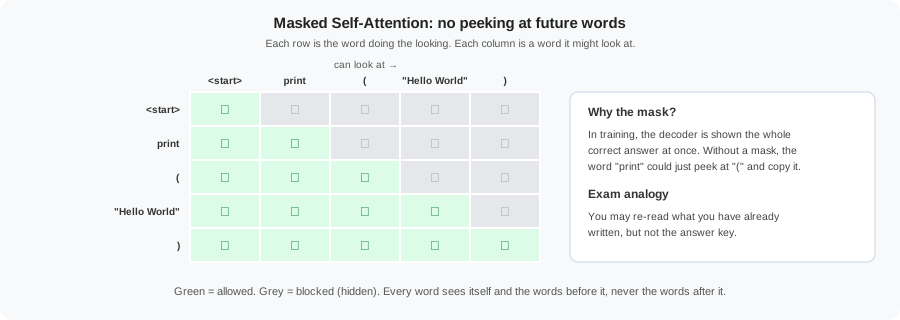
Why? During training the decoder is shown the whole correct answer at once, so it can learn from all positions in parallel. Without the mask, the position after “print” could simply peek at “(“ and copy it. It would learn nothing.
Analogy: an exam. You can re-read your own earlier answers, but you can’t look at the answer key.
Box 6: Cross-Attention (checking the reading team’s notes)
Next, the decoder asks the encoder for help. In cross-attention:
- the Queries come from the decoder (“what do I need to write next?”)
- the Keys and Values come from the encoder’s
z1 … z6(“here is what the input says”)
So when the decoder is about to write the text inside the brackets, its query matches the keys of Hello and World, and it pulls in their meaning.
Analogy: the writing team glancing back at the reading team’s notes before writing each word.
This is the same “decoder looks back at the encoder” idea from Part 3, now built entirely from Query, Key and Value.
Then: Feed-Forward, Add & Norm, stacked six times
Exactly as in the encoder. One decoder layer = masked self-attention → cross-attention → feed-forward, each followed by add & norm, and six layers stacked.
6. Box 7: Linear + Softmax (picking the next word)
At the top, the decoder has one vector for the current position. It must turn that into an actual word.
- Linear: give a score to every word in the vocabulary (tens of thousands of possible words).
- Softmax: turn those scores into probabilities that add up to 1.
After "<start> print (" the model might say:

  "Hello World"   0.82   ← pick this one
  "Hi"            0.06
  )               0.04
  ...everything else shares the remaining 0.08
Analogy: a multiple-choice question with thousands of options, where the model writes down how confident it is in each.
Real models split text into tokens, which are often pieces of words. Treating
"Hello World"as one token here just keeps the example tidy.
7. Putting it all together: writing the code
The encoder reads the input once. The decoder then runs in a loop, adding one word per step, until it produces a special <end> word:
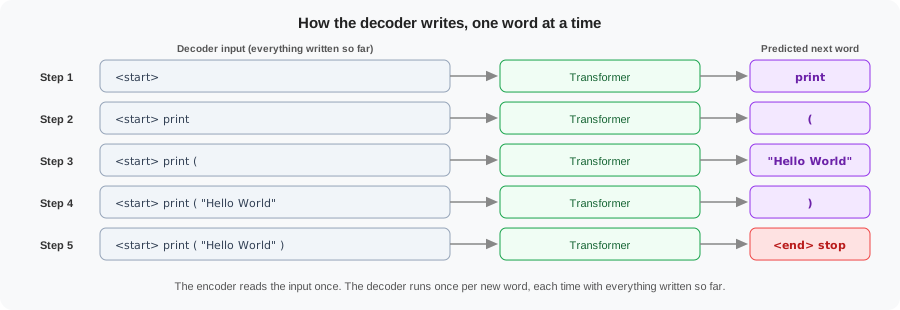
Final output:
print("Hello World")
Here is the whole journey in one list:
- Embed the input words and add positions.
- Encoder × 6: words discuss (multi-head self-attention), then think alone (feed-forward). Result:
z1 … z6. - Decoder starts with
<start>, embeds it and adds positions. - Decoder × 6: look at what’s been written (masked), check the encoder’s notes (cross-attention), then think alone (feed-forward).
- Linear + Softmax picks the next word.
- Add that word to the output and go back to step 3, until
<end>.
8. The original numbers
From the 2017 paper Attention Is All You Need (base model):
| Setting | Value | What it means |
|---|---|---|
| Encoder layers | 6 | Six stacked encoder layers |
| Decoder layers | 6 | Six stacked decoder layers |
| Vector size (d_model) | 512 | Numbers per word vector |
| Attention heads | 8 | Eight discussions at once |
| Size per head | 64 | 512 ÷ 8 |
| Feed-forward size | 2048 | Temporary width inside the feed-forward network |
| Parameters | ~65 million | Tiny next to today’s large language models |
9. Where you meet this today
The same building blocks power modern AI. Different models keep different halves:
| Type | Keeps | Good at | Examples |
|---|---|---|---|
| Encoder–decoder | Both halves | Turning one sequence into another | Original Transformer, T5 (translation, summarisation) |
| Encoder-only | Just the encoder | Understanding text | BERT (search, classification) |
| Decoder-only | Just the decoder (without cross-attention) | Generating text | GPT-style chatbots and most modern LLMs |
A chatbot that writes an answer word by word is doing the loop from section 7. There’s just no separate encoder: your question simply becomes the start of the “output so far”.
These three families — why they exist and how to pick between them — get a full part of their own: Part 11: Transformer Variants.
10. Summary
| Box | Name | One-line job | Analogy |
|---|---|---|---|
| 1 | Input Embedding | Words → vectors | A dictionary of number codes |
| 2 | Positional Encoding | Add word order | A seat number on a cinema ticket |
| 3 | Multi-Head Self-Attention | Words share information | Several group discussions at once |
| — | Add & Norm | Keep the original, tidy the numbers | Keep your notes; adjust the volume |
| 4 | Feed-Forward | Each word processes alone | Thinking it over at home |
| 5 | Masked Self-Attention | Look only at words written so far | No peeking at the answer key |
| 6 | Cross-Attention | Decoder checks the input | Glancing at the reading team’s notes |
| 7 | Linear + Softmax | Choose the next word | A multiple-choice answer with confidences |
Next up: the math. How are Q, K and V actually computed, and how does attention turn into a few matrix multiplications? See Part 9: The Math Behind Self-Attention.