
Deep Learning for Generative AI — Part 9: The Math Behind Self-Attention (The Magic Is a Matrix)
Deep Learning for Generative AI — Part 9: The Math Behind Self-Attention (The Magic Is a Matrix)
People often call GPT and Transformers “magic”. Here’s a better word: matrix.
Everything we described with the group project analogy (queries, keys, values, “who listens to whom”) comes down to a few matrix multiplications. In this part we’ll write them down and then work through a tiny example by hand, so you can see every number.
Where this fits: Part 4 covered the math of attention v1 — an RNN decoder attending to encoder states. This part covers self-attention — words in the same sequence attending to each other, which is what the Transformer runs on. Same ingredients (dot products, scaling, softmax, Q/K/V), different recipe: here Q, K and V all come from the same sentence via three learned matrices.
If you need a refresher on dot products or softmax, Part 4 covers them. Here we only use what we need.
1. Setting up the notation
Take a sentence with N words. We’ll use a new, tiny example:
"cats chase mice" → N = 3 words
We need two sizes:
| Symbol | Meaning | In our example |
|---|---|---|
| N | Number of words in the input | 3 |
| D1 | Length of each word’s starting vector (its plain embedding) | 4 |
| D2 | Length of each word’s rich vector z (the model size we want) |
2 |
The starting vectors x1, x2, x3 are plain, “static” descriptions of each word. They are the same no matter what sentence the word is in. The whole point of attention is to turn them into rich vectors z1, z2, z3 that know about their neighbours.
(Real models use sizes like D1 = D2 = 512. We use tiny sizes so you can check the arithmetic.)
2. Stack the words into one matrix, X
Instead of handling words one at a time, we stack them as rows of one matrix:
            ← D1 = 4 columns →
X =  cats   [ 1   0   1   0 ]      row 1 = x1
     chase  [ 0   2   0   1 ]      row 2 = x2
     mice   [ 1   1   0   0 ]      row 3 = x3

size: N × D1 = 3 × 4
One row per word. That’s all X is. The numbers here are made up to keep things simple.
3. The three learnable matrices: W_Q, W_K, W_V
Where do queries, keys and values come from? From three matrices the Transformer learns during training:
| Matrix | Size | Produces |
|---|---|---|
| W_Q (query weights) | D1 × D2 | Queries: what each word is looking for |
| W_K (key weights) | D1 × D2 | Keys: what each word can offer |
| W_V (value weights) | D1 × D2 | Values: what each word actually knows |
“Learnable” means they start as random numbers and get adjusted, bit by bit, during training. Here’s the chain that makes them so important:
good W_Q, W_K, W_V
   → good queries, keys and values
      → good attention weights
         → good rich representations
            → good translations / answers
Training a Transformer’s attention is essentially the search for the best W_Q, W_K and W_V.
4. Step 1: get Q, K, V with one multiplication each
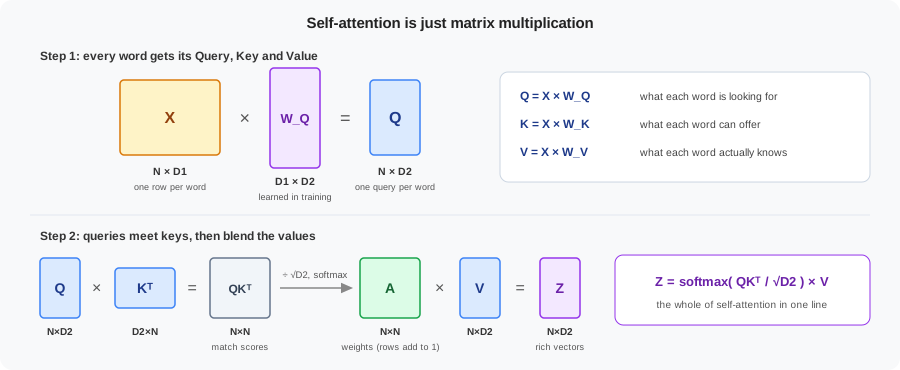
Q = X × W_Q        (N × D1) × (D1 × D2)  =  N × D2
K = X × W_K        same shape
V = X × W_V        same shape
One multiplication gives the queries of all words at once, with row 1 for cats, row 2 for chase, row 3 for mice. No loop over words. This is why Transformers are so fast on GPUs.
Let’s use these small learned matrices (again, made-up numbers):
W_Q = [ 1 0 ]     W_K = [ 0 1 ]     W_V = [ 1 0 ]
      [ 0 1 ]           [ 1 0 ]           [ 0 1 ]
      [ 1 0 ]           [ 1 0 ]           [ 1 1 ]
      [ 0 1 ]           [ 0 1 ]           [ 0 0 ]
Multiply X by each one (each entry is “row of X” · “column of W”):
            Q            K            V
cats    [ 2  0 ]     [ 1  1 ]     [ 2  1 ]
chase   [ 0  3 ]     [ 2  1 ]     [ 0  2 ]
mice    [ 1  1 ]     [ 1  1 ]     [ 1  1 ]
Check one: the query of cats = [1 0 1 0] × W_Q → first column: 1·1 + 0·0 + 1·1 + 0·0 = 2, second column: 1·0 + 0·1 + 1·0 + 0·1 = 0. So q_cats = [2, 0]. ✓
5. Step 2: queries meet keys with QKᵀ
In the group project, you listen most to the friend whose key matches your query. “Match” in math is the dot product: bigger when two vectors point the same way.
To match every query with every key in one go, multiply Q by the transpose of K (Kᵀ: flip rows into columns):
Q × Kᵀ (N × D2) × (D2 × N) = N × N
The result is an N × N table of scores. Row i, column j = how well word i’s query matches word j’s key.
                    keys of →   cats   chase   mice
scores = Q Kᵀ =   cats query  [  2      4      2  ]
                  chase query [  3      3      3  ]
                  mice query  [  2      3      2  ]
Check one: cats’ query [2, 0] · chase’s key [2, 1] = 2·2 + 0·1 = 4. That’s the highest score in the cats row, so cats wants to listen to chase the most.
6. Step 3: scale, then softmax to get weights
Two small steps turn scores into attention weights.
Scale by √D2. Divide every score by √D2 (here √2 ≈ 1.41). With big vectors, dot products get very large and softmax becomes too “extreme” (one word gets everything). Scaling keeps things calm. The original paper uses exactly this.
scores ÷ √2 =  [ 1.41  2.83  1.41 ]
               [ 2.12  2.12  2.12 ]
               [ 1.41  2.12  1.41 ]
Softmax each row. We want weights that are positive and add up to 1 (a convex combination, as in Part 4). Softmax does exactly this:
softmax(z)_i = e^(z_i) / (e^(z_1) + e^(z_2) + ... + e^(z_n))
Quick example with the numbers 1, 2, 3:
e^1 = 2.72    e^2 = 7.39    e^3 = 20.09     total = 30.20

weights = 2.72/30.20, 7.39/30.20, 20.09/30.20  =  0.09, 0.24, 0.67   (adds to 1 ✓)
Because e^x is always positive, softmax works even when scores are negative, and the biggest score always gets the biggest share.
Applying softmax to each row of our scaled scores gives the attention weights A:
                  cats   chase   mice
A =   cats     [ 0.16   0.67   0.16 ]     ← cats listens mostly to chase
      chase    [ 0.33   0.33   0.33 ]     ← chase listens to everyone equally
      mice     [ 0.25   0.50   0.25 ]     ← mice leans towards chase

(each row adds to 1, allowing for rounding)
Notice the chase row: its query matched every key equally (all scores were 3), so it splits its attention evenly. In a trained model, W_Q and W_K would be tuned so the useful words stand out.
7. Step 4: blend the values with A × V
Last step, the “collective knowledge” from the group project. Each word’s new vector is a weighted blend of everyone’s values, using its row of A:
Z = A × V (N × N) × (N × D2) = N × D2
For cats:
z_cats = 0.16 × v_cats + 0.67 × v_chase + 0.16 × v_mice
       = 0.16 × [2, 1]  + 0.67 × [0, 2]  + 0.16 × [1, 1]
       = [0.49, 1.67]
Doing all three rows at once:
            Z
cats    [ 0.49  1.67 ]
chase   [ 1.00  1.33 ]
mice    [ 0.74  1.50 ]
We started with plain 3 × 4 word vectors and ended with rich 3 × 2 vectors, one per word. Each is built from the whole sentence. “cats” now carries a lot of “chase” in it: it’s no longer just cats, it’s cats that are doing the chasing.
8. The whole thing in one line
Every step above fits in one famous formula:
Z = softmax( Q Kᵀ / √D2 ) × V where Q = X W_Q, K = X W_K, V = X W_V
Read it right to left with the group project in mind:
| Piece | Math | Group project meaning |
|---|---|---|
X W_Q, X W_K, X W_V |
Three matrix multiplications | Everyone reads alone and forms questions, insights, understanding |
Q Kᵀ |
Dot product of every query with every key | Whose insights answer whose questions? |
/ √D2 |
Scaling | Keep the discussion calm |
softmax(...) |
Rows become weights that add to 1 | How much you listen to each friend |
× V |
Weighted sum of values | Walk away with the group’s collective knowledge |
And the shapes:
X (N × D1) → Q, K, V (N × D2) → scores and A (N × N) → Z (N × D2)
Multi-head attention (Part 8) simply runs this whole recipe several times in parallel, each head with its own W_Q, W_K and W_V, and then joins the results.
9. Summary
- The “magic” of Transformers is matrix multiplication.
- Stack the N word vectors as rows of X (N × D1).
- Three learned matrices W_Q, W_K, W_V (D1 × D2) turn X into Q, K, V (N × D2) in one multiplication each.
- Q Kᵀ gives an N × N table of how well each word’s query matches each word’s key.
- Divide by √D2, then softmax each row so the weights are positive and add to 1.
- A × V blends everyone’s values into rich vectors Z (N × D2).
- Training is the search for W_Q, W_K, W_V that make these blends as useful as possible.
Next up: run all of this yourself in about 15 lines of Python in Part 10: Self-Attention in Code with NumPy.